Published on January 20th 2026 | 10 mins , 1839 words
SECTION A (40 marks)
Answer all the questions in this section in the spaces provided.
1. The following diagram illustrates a light microscope.
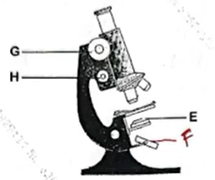
Name the part labelled E. (1 mark)
Condenser;
(b) Label on the diagram with a letter, F, the part that reflects light to the specimen. (1 mark)
(c) State the function of the part labelled H. (1 mark)
Moves the body tube for sharper/clear/fine focus; (For comparative raises and lowers body tube)
(d) Explain the precautions that should be taken while using the part labelled G. (2 marks)
- Should not be used while focusing with high power objective lens; since it can damage the objective lens or break the slide/damage specimen;
- Should only be used when focusing with low/medium power objective lens; avoid breaking the high power objective lens/slide/destroy the specimen;
(e) Describe how one can determine the magnification of a specimen viewed under the microscope. (2 marks)
Multiply the eye piece (lens) magnification; by objective (lens) magnification; (MG) (MG) Total magnification = Eye piece (lens) magnification X objective lens magnification;
(f) During a microscopy lesson, two groups of students observed different numbers of cells from the same slide using identical microscopes. Suggest the likely cause of the difference. (1 mark)
Difference in the diameter / differences in objective lenses used; or location of field of view;
2 In an experiment, students made some marks on the root of a germinating bean plant as shown in the following diagram.
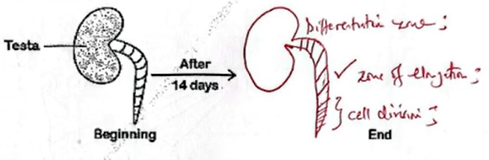
(a) State the aim of the experiment. (1 mark)
To determine/investigate the region of (primary) growth; NB: Accept zone for region. Reject rate of growth, seed, seedling, shoot.
(b) (i) On the space provided on the right side of the diagram, sketch the appearance of the marks on the root after 14 days. (1 mark)
(ii) Account for the appearance of the marks on the sketch made in (b)(i). (3 marks) (Tied to b(i))
Markings at the tip and base remain the same. Behind the tip the markings become more spread; Tip is the region of cell division; behind the tip is the region of cell elongation; at the base there is the region of cell differentiation/specialization;
(c) State two materials the students would require to undertake the experiment. (2 marks)
Ink/permanent ink/marker pen/indelible ink/Indian ink; Pin; filter/blotting paper; moist cotton wool/water/moisture; Ruler; piece of thread; Beaker; Cork
(d) State the role of the testa during germination. (1 mark)
Provides protection to the embryo/cotyledons/plumule (inner parts of the seed); Reject protection of seed/seedling/plant
3 (a) In a certain variety of pea plants, the allele for smooth seed coat is dominant over the allele for wrinkled seed coat. Using letter R to represent the allele for smooth seed coat, determine:
(i) the genotypic ratio of the F1 generation if two heterozygous pea plants were crossed; (5 marks)
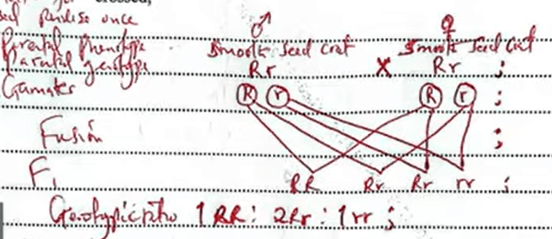
No. of seeds with wrinkled seed coat=1/4×12,000 or 25% of 12,000;
=3,000 (seeds);
(b) State the advantage of using pea plants over eucalyptus plants in genetic studies. (1 mark)
— Shorter generation time/life cycle/mature faster;
— Pea plants do not occupy as much space as eucalyptus trees;
— Exhibits distinct/contrasting traits/discontinuous variations;
— Can self or cross pollinate/breed easily;
— Easy to grow/simple to cultivate/yield/produces numerous
4. The following diagram represents a section of the mammalian skin.
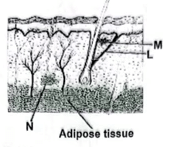
(a) Name the part labelled M. (1 mark)
Sebaceous gland(s);
(b) Explain the roles played by the parts labelled N and L in thermoregulation during hot weather conditions.
(i) N (3 marks)
Produces sweat; which moves through the sweat duct to the skin surface; where it vaporizes; to bring about cooling effect;
(ii) L (3 marks)
(Erector Pili muscle) relax; causing the hair (on the skin surface) to lie flat/decreases angle; thus no/less layer of air is trapped on the skin/no or less insulation; the body loses excess heat/encourages heat loss/water vaporizes;
(c) Explain why aquatic animals have a thicker adipose tissue. (1 mark)
- For insulation against heat loss (in cold aquatic habitats);
- For buoyancy;
5. The following diagram represents a section of the human female reproductive system
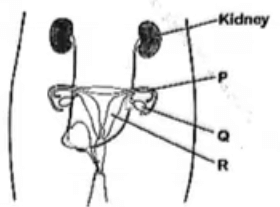
(a) Name the part labelled P. (1 mark)
- Oviduct / fallopian tube;
(b) State two functions of the part labelled R. (2 marks)
- Contracts to facilitate birth;
- Delivery / pushing out / expulsion of the foetus (during parturition / birth)
- Holding or protecting (developing) foetus / embryo;
- Implantation (of the blastocyst);
- Nourishment of foetus (through formation of placenta);
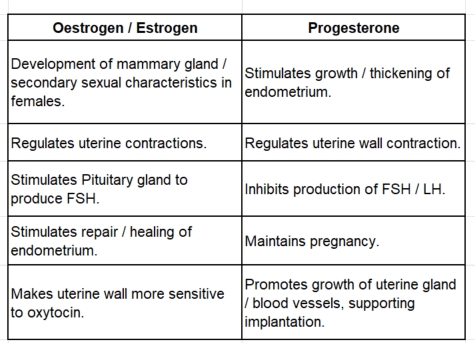
(c) (i) Name the hormone secreted in the part labelled Q. (1 mark)
- Oestrogen / estrogen / Progesterone;
(ii) State the roles of the hormone named in (c)(i). (2 marks)
For growth and development of foetus.
Replenish proteins used by foetus.
For growth and development of mother's body.
In an investigation, blood flowing in two blood vessels, W and X of a healthy adolescent was measured within a minute and recorded as shown below.
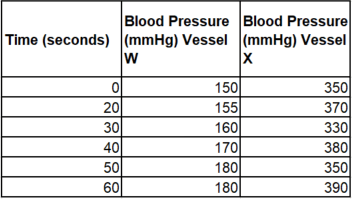
Tips for Plotting This Graph
To earn the full 7 marks indicated in the marking scheme (A-1, S-2, P-2, C-1, I-1), ensure you follow these graphing standards:
- A (Axes): Time (seconds) should be on the horizontal x-axis, and Blood Pressure (mmHg) on the vertical y-axis.
- S (Scale): Use a consistent scale that covers more than half of the grid. For the y-axis, you might start from 0 or use a "break" (zigzag) to start closer to 100 to show the detail clearly.
- P (Plotting): Accurately mark each data point for both Vessel W and Vessel X.
- C (Curve): Join the points with smooth lines or straight lines as required by your specific syllabus (usually a smooth curve or line of best fit).
- I (Identity): Clearly label which line is Vessel W and which is Vessel X (e.g., using a key or different colors/line styles).
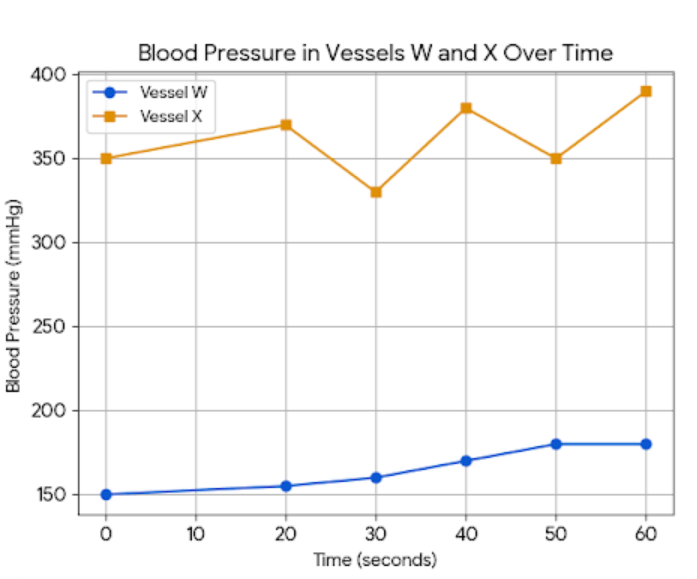
(b) State the likely identity of the blood vessels, W and X.
- W: Veins; Accept any correctly named Vein; (1 mark)
- X: Artery; Accept any correctly named artery; (1 mark)
(c) Explain your answer in (b). (3 marks)
- W – Blood in Veins flows at lower/low pressure; and smoothly; due to resistance of blood flow in the capillaries; and a wide lumen;
- X – Blood in artery flows at a high/higher pressure; and intermittently/in pulses; due to pumping action of the heart; and narrow lumen.
(d) (i) Compare the blood pressure in an adolescent boy and a sixty year old man. (1 mark)
- Blood pressure of an adolescent is higher than blood pressure of a 60 year old; (Accept converse)
(ii) Explain your answer in (d)(i). (3 marks)
- The adolescent boy is more active/has faster growth/higher BMR than a 60 year old;
- Blood pressure is higher to ensure faster supply of nutrients/oxygen; for respiration; faster removal of metabolic waste products;
(f) Explain the role of blood in:
(i) temperature regulation; (2 marks)
- Heat distribution / carry heat from (liver) core body parts to peripheral organs / tissues;
- Excess heat is lost through radiation/convection/evaporation;
- Thermoregulation centre / hypothalamus trigger responses to cool / warm the body;
(ii) disease control. (2 marks)
- Transportation of immune cell / white blood cells;
- Distribution of antibodies;
- Removal of pathogens / toxins;
- Through blood clotting, pathogens are prevented from entering the body;
7 (a) Describe the role of the stomach in digestion. (5 marks)
Produces HCl; activates enzymes pepsinogen / prorennin; destroys pathogens;
Produces digestive enzymes / gastric juice / pepsin / rennin; for digestion of proteins; (Accept a correct named enzyme and 1/2 function)
Has muscles (longitudinal and circular / smooth) which contracts and relax; mixes food with digestive enzymes / churning of food;
Stores food (temporarily) allowing time for chemical digestion;
Produces hormones/gastrin; that stimulates production of gastric juice/hydrochloric acid;
Produces mucus; that protects the stomach wall from corrosion by digestive enzymes/HCL;
7 (b) Describe the mechanisms that lead to the opening of the stomata during the day. (15 marks)
Photosynthetic Theory; the chloroplasts; in the guard cells trap light for photosynthesis; leading to accumulation of glucose/sugar;
Increasing the osmotic potential / pressure;
Water (molecules) from the adjacent neighboring cells is drawn into the guard cells; by Osmosis;
Guard cells become turgid; the inner wall is thicker than the outer wall / inner wall is less elastic than outer wall;
Guard cell bulge outwards; Equivalent to inner wall less elastic compared to outer wall;
The outer wall stretches more; pulling the inner wall; opening the stomata;
Potassium ion Theory: (during the day) ATP is formed;
Potassium ions move into the guard cell; by active transport / Potassium ion pump; increasing solute concentration;
Osmotic pressure / osmotic potential; water moves into the guard cells; by Osmosis; making guard cells turgid;
Opening the stomata;
8 (a) Explain the forces involved in the uptake of water in terrestrial plants. (5 marks)
Transpiration pull: involves the vaporization of water from the spongy mesophyll cells; into the sub-stomatal air spaces; making their cell sap more concentrated than the adjacent cells;
This increases the osmotic pressure of the spongy mesophyll cells; promoting the flow of water into the cells from the surrounding cells;
This in turn pulls in the water from xylem vessels within the leaf veins; the events create a force that pulls a stream of water from the xylem vessels in the stem and roots;
Capillarity: water rises in the xylem vessel until the weight of the water column balances the attractive forces operating between the water and the walls of the xylem vessel;
In addition, water rises within the xylem vessel because they are narrow;
Cohesion and adhesion forces: Cohesion is the attraction of water molecules to one another while adhesion is the attraction between water molecules and the walls of the xylem vessel;
The two forces are very high in thin columns such as the xylem vessel and are not easily broken; hence a continuous flow / transpiration stream is maintained;
Root pressure: It may be attributed to the active / continuous pumping of salts across the endodermis into the xylem vessels; this causes water to rise up the plant and water moves into the xylem (by osmosis);
8 (b) While playing, a student was pricked by a thorn on the hand. The student screamed and quickly withdrew the hand from the thorn. Describe the activities that led to the withdrawal of the hand from the thorn. (15 marks)
This is an automatic response / simple reflex action;
the pathway of this response is a reflex arc; pain receptors in the skin; were stimulated; nerve impulse were triggered/generated/initiated; and transmitted; via sensory neurone; via the dorsal root; of the spinal cord; impulse is transmitted to the relay neurones; via a synapse; then to motor neurone; through another synapse; and eventually through the ventral root; via another synapse to the effector muscle/ biceps; muscle contracts; and withdrawing the forearm.