Published on February 10th 2026 | 10 mins , 1999 words
State four internal environmental factors which influence the performance of a business
a) The management styles and policies.
b) The skills, knowledge and attitudes of employees. /human resources
c) The business culture and values.
d) Objectives of the business. / owners
e) The finances (capital) available to the business.
f) Business organization in terms of departments, divisions and work flows /Business structure
g) Physical resources.
h) Technology
i) Research and development.
2. Outline four advantages of using aeroplanes for transport.
a) It is the fastest means of transport hence suitable for transporting perishable goods.
b) It is very flexible and can reach even remote areas by use of helicopters.
c) It limits the risk of loss/secure through theft i.e valuable goods like jewellery, gold etc.
d) Allows very limited handling of goods/hence minimizing the risk of damage.
e) Apart from the construction of air terminals, the way is free as provided by nature.
f) Ease of connectivity between airlines makes it convenient.
g) It is ideal for long distance travelling especially from one continent to another.
h) It is reliable as it follows strict time schedule
i) Accidents are rare/safe
3. Factors leading to a shift in the supply curve
Factors that may lead to a shift of the supply curve as shown (reduced supply) include:
- a) ~~Decreasing product prices~~ Decline in level of technology
- b) Increasing prices of substitute goods that can be produced using same resources (inputs).
- c) Decreasing prices of jointly produced goods or complimentary goods.
- d) Increased prices of factor inputs.
- e) The good could be out of season.
- f) Increased government taxes / unfavourable government policy
- g) Withdrawal of many firms from the market.
- h) Unfavourable natural factors
- i) Future expectation of increase in price of the commodity
- j) Industrial unrest
4. Ways of controlling cost-push inflation include:
- a) Offering government subsidy to lower the cost of production.
- b) Setting maximum and minimum wage levels, to reduce agitation for pay increase.
- c) Controlling the price of inputs and making it affordable for industries e.g raw materials
- d) Storing buffer stocks of inputs such as crude oil to cushion increase in their prices.
- e) Lowering production taxes to ensure prices are kept low but still profitable.
- f) Improved infrastructure to facilitate access and lower transportation costs.
- g) Lowering the profit margins
- h) Controlling land rates/Rent
- i) Controlling interest on capital
5. Functions of an office includes:
- a) A communication centre for the organization.
- b) A centre for ~~handling and~~ Producing reproducing documents.
- c) Safeguards and controls organization's property.
- d) Administrative centre for coordinating day-to-day activities of the organization.
- e) Management of records through appropriate filing.
- f) A centre for processing data for decision making.
- g) Liaison with other businesses and stakeholders.
- h) mailing
- i) distribution of information
- j) receiving information
- k) Recording information
6. Circumstances under which a co-operative society may be dissolved include:
- a) When members agree to dissolve the co-operative by a resolution at an annual general meeting.
- b) When there is a continuous and persistent disagreement of members making cooperation impossible.
- c) When there is a withdrawal of members resulting into the membership falling below 10.
- d) When the cooperative becomes insolvent.
- e) When there is an order of dissolution by the parent ministry.
- f) When there is a court order of dissolution out of legal petition by members or other parties.
- g) When the cooperative society has achieved the intended purpose
- h) when there is persistent loss making
7. Problems that may be encountered when measuring national income using the output approach include:
- a) Difficulty in deciding on the goods and services to be included or excluded.
- b) Valuing illegal activities like sale of illicit brew and drugs though they generate a lot of income.
- c) Lack of accurate output figures, especially in the private sector.
- d) Valuing government output since its services are offered at rates below market values.
- e) Changing product values as per market demand that makes it difficult to determine / price fluctuation.
- f) Difficulty in valuing products from the subsistence sector.
- g) Inadequate data
- h) Double counting
- i) Difficulty in estimating value of wear and tear / depreciation
- j) Difficult in establishing the value of interme-
8. [Numerical Data Section]
- a) 872,900 ✓
- b) 1,145,400 ✓
- c) 855,500 ✓
- d) 545,300 ✓
9. Features of indirect production includes:
- a) Goods are produced with a view of exchange.
- b) It results in large scale production/ Large quantity.
- c) Producer specializes in one or a few areas of production.
- d) Higher quality goods are produced.
- e) Machines are often employed in the production process/ Modern technology.
- f) Creates interdependence between people and countries.
- g) Surplus production of goods.
10. Qualities of money include:
a) Should be durable.
b) Should be divisible.
c) Should be generally accepted.
d) Should not be easy to forge.
e) Should be easy to cast into various shapes (malleable).
f) Should be easy to carry around (portable)
g) should be easy to recognize (cognizability)
h) should be stable in value (stability)
i) should be homogeneous (homogeneity)
j) should be scarce (scarcity)
11. Factors that may be considered when choosing the location of a warehouse include:
- a) Availability of land for future expansion.
- b) Adequate security to ensure safety of goods and physical structures.
- c) Availability of transport network to enhance accessibility.
- d) The purpose of the warehouse whether for private or public use or bonded.
- e) Government regulations which determine establishment of a warehouse.
- f) Effects of weather to ensure safety from natural calamities.
- g) Availability of communication network
- h) Availability of auxiliary services e.g bank
- i) Availability of skilled labour
13 Measures that the Kenyan government may take to improve her earnings from exports include:
a) Aggressive marketing of Kenyan goods in foreign countries through commercial attaches.
b) Diversification of exports to increase the range of commodities sold in other countries.
c) Devaluation of local currency making Kenyan goods more affordable to foreigners.
d) Establishment of export processing zones to target production of high quality goods for exports.
e) Invest in value addition of primary goods so as to export finished products.
f) Join economic bloc to widen the market for Kenyan goods.
g) Giving subsidies to exporters
h) Export compensation scheme
i) Offering customs drawbacks
14. Merits of the SMS when communicating include:
a) It provides evidence which can be kept for future reference.
b) It is reliable and cannot be affected by element of weather like wind/rain.
c) The same message can be sent to several recipients at a go.
d) SMS is less prone to distortion.
e) It is relatively cheap.
f) It is fast.
g) It provides record which can be kept for future reference.
h) It is confidential.
Reasons for continued existence of small firms in the economy include:
a) They require small capital investment.
b) Some markets can only be served by small firms.
c) Government policy encouraging their existence.
d) Desire for people to own their own firms.
e) It is fast to make decisions as people involved are fewer or solo.
f) They are flexible as one may move from one type of business to the other.
g) It is believed that small firms are manageable.
h) They require fewer legal formalities to form
i) The nature of the product
16. Ways in which the government regulates business activities in Kenya include:
a) Through licensing.
b) Through legislation.
c) Application of appropriate tax regimes.
d) Setting up regulatory bodies like KEBS.
e) Enforcement of the laws governing business activities.
f) Formulation of policies e.g fiscal and monetary policies.
g) Fixing quotas on goods to be produced.
h) Imposing total ban on certain goods and services e.g drugs.
i) Offering subsidies to businesses / producers
j) Through price control
17. Demerits of personal selling include:
a) It is limited in coverage since salesperson can only be in one place at a time.
b) It is expensive as sales persons have to be paid.
c) It is time consuming as it involves bargaining and demonstrating the use of the products.
d) Possible misuse of resources allocated to sales persons. e) Sales may not be guaranteed since this depends on the mood of both sales persons and prospective customer.
f) It may be less attractive to introverts who are interested to buy and not to listen to the sales pitches.
g) It may inconvenience the target buyer.
h) It may lead to impulse buying
18. Circumstances under which a buyer would pay for goods by use of mobile phone payment system include: a) When the buyer has sufficient funds in the mobile phone payment account to pay for the goods.
b) When the business allows for payments by use of mobile phone payment system.
c) When the buyer doesn't have cash at hand or cheques.
d) When it is the policy of the business to only accept payments by mobile phone account.
e) When the buyer has no funds but can access digital credit from the digital lenders and banks to pay.
f) When there are health concerns which discourage handling of cash in the business.
g) When there is need to ensure security and safety of funds for the business and the customer/large amount of money.
h) When there is need for evidence of payment
19. Effects of the business transactions on the capital of the business:
- a) Increases
- b) Decreases / reduces
- c) Decreases / reduces
20. Factors that an entrepreneur should consider when evaluating a business idea include:
- a) Profitability of the idea.
- b) Access to appropriate technology for implementing the idea.
- c) Availability of market.
- d) Prevailing culture (attitude, practices and beliefs).
- e) Appropriate skilled labour (employees/Entrepreneur)
- f) Government policy.
- g) Impact on the environment.
- h) Availability of raw materials/stock
- k) Financial requirements
- l) Commitment to the business
- m) Risks involved
21. The following information was extracted from the books of Tanashati Traders on 31st December 2024.
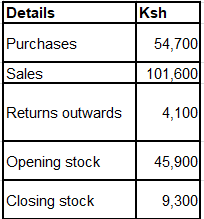
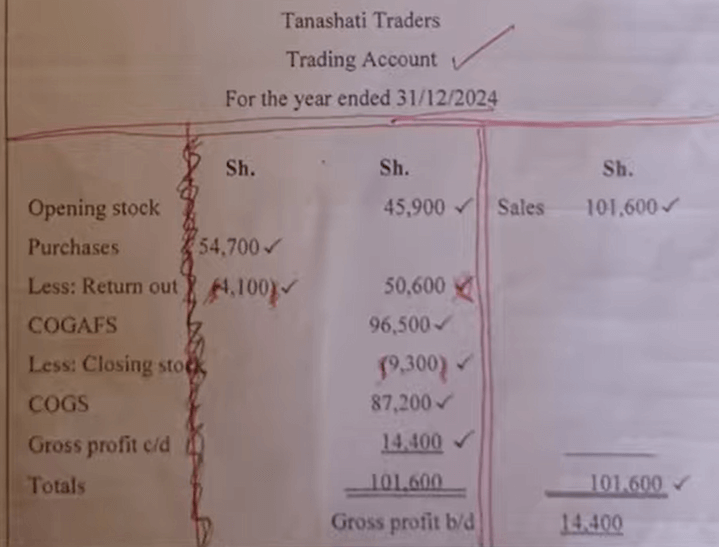
Required: Prepare Tanashati Traders’ Trading Account for the year ended 31st December 2024. (5 marks)
- a) Offer tax relief to firms being located in rural areas.
- b) Development of infrastructure (roads, electricity, water etc)
- c) Provide security in rural areas.
- d) Implement friendly licensing procedures.
- e) Extend subsidies to the firms.
- f) Offer land at affordable rates.
- g) Offer affordable loans
23. Reasons that may make a manufacturer to sell goods directly to the consumers include:
- a) Production of technical goods that require installation/demonstration
- b) Existence of manufacturers retail outlets.
- c) Large scale purchases from the manufacturers.
- d) Dealing in highly valued goods like gold.
- e) Where buyers are close to the manufacturer/concentrated
24. state characteristics of itinerant traders.
- a) They are small scale traders.
- b) They move from one place to another selling their goods.
- c) They operate on cash basis.
- d) They have no fixed prices for their goods.
- e) They require little capital to start.
- f) They are usually very persuasive.
- g) Operate in densely populated areas like market places.
- h) can easily change from one place to another
- i) Mostly deal in fast moving goods
- j) operate without shops
- i) Govt policy
- j) To keep prices low for consumers
- k) To avoid tampering with the product
- l) production of low output
- m) To get immediate feedback
25. Highlight four Disadvantages of public limited companies
- a) Lengthy formation processes.
- b) Lack of secrecy due to the legal requirements of publishing financial records.
- c) Slow-decision making due to the long vetting process by shareholders.
- d) Double taxation in that, the company profits and dividends to shareholders are all taxed.
- e) Operations are restricted to what is specified in the Memorandum of Association.
- f) Owners give up control of companies to hired professionals.
- g) Consequences of bad decisions made by managers as agents is borne by the shareholders/Conflict of interest
- h) May suffer diseconomies of scale due to large size
- i) Requires high initial capital
- j) High cost of formation