Published on February 12th 2026 | 13 mins , 2500 words
- What is land rehabilitation?
- It is the process of restoring / bringing land back to its former productive state.
(b) State three benefits of Zuider Zee project in the Netherlands.
- It has created a large fresh water lake / reservoir / Lake Yssel
- The reclaimed polders have led to growth of towns.
- The coastline distance was shortened. / Improved transport
- The salinity of the soils has been lowered.
- There is reduction of tidal floods.
- More agricultural land has been created. / More food production
- There was improved drainage in the former Zuider Zee area.
- More land for settlement / industries was created.
- It has created employment opportunities /
2. Identify the fishing method shown below
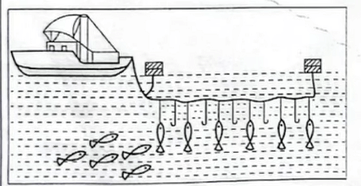
b) Describe the basket method of fishing.
- A woven cone-shaped basket with a wide opening is used.
- A bait is placed inside the basket.
- The basket is lowered in shallow water/ponds/end of a lake/river.
- The basket is held in place by ropes/stones/sticks to prevent it from moving.
- The bait attracts fish into the basket.
- Once the fish is caught it is hauled/pulled out of the water.
- The fish is removed / basket emptied.
- The process is repeated till enough fish is caught.
3. Explain how each of the following challenges facing wildlife in East Africa can be controlled.
Poaching
- Establishment of anti-poaching units to protect wild animals.
- Enforcing a ban on trade in wildlife products to kill the demand.
- Imposing very heavy penalties on offenders to deter them.
- Enhancing / creating public awareness on the importance of wildlife hence conserve them.
- Use of modern surveillance technologies/cameras/drones to track and secure wildlife.
- Establishing sanctuaries for endangered animals/species to protect them.
- Installation/erecting electric fences around game parks to keep off poachers.
Human-wildlife conflicts
Installation/erecting of electric fences around the game parks to keep off the animals.
Relocating troublesome animals to less populated areas to minimize interactions.
Strobe/automatic light machine to scare off destructive nocturnal animals
Use of ~~natural~~ barriers such as bees/hot pepper to keep them off.
Preserve wildlife corridors to minimize stray movements
Compensating people for losses/damages caused by wild animals.
Evicting people who have encroached into wild life habitats
4. (a) State two sources of population data
- ~~Primary sources~~/
- National census/head count/sample surveys/
- ~~Sample surveys~~ Registration
- ~~Records of births and deaths~~/Marriage/Migration/vital statistics.
- Secondary ✓ sources/Census reports/textbooks/Journals/Periodicals/magazines/statistical abstracts.
b) Give three reasons for the high population density in Central Kenya.
- Availability of water/many permanent rivers.
- ~~Favourable/Cool climate.~~ to warm climate / 10∘C−20∘C
- Endowed with deep/well drained/volcanic soils.
- Numerous accessible roads that serve most parts.
- Low incidences of pests.
- Numerous industries/job opportunities.
- high rainfall/ 1000−2000mm per annum.
- Proximity to Nairobi
- Historical settlement
5. State five ways that can be used to reduce incidence of human diseases in Kenya.
- Maintaining a clean environment. ✓/Good hygiene.
- Immunisation of humans. ✓
- Educating people on/✓correct use of chemicals.
- Use of pesticides. ✓
- Creating awareness on diseases$\checkmark$ to prevent their spread e.g HIV/AIDs, COVID-19.
- Wearing protective gears / masks. ✓
- Encouraging physical exercises. ✓
- Taking a balanced diet. ✓
- Quarantine/ containment to avoid the spread
6. Study the photograph provided and answer questions (a), (b) and (c).
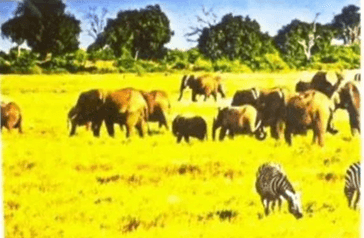
(i) Identify the type of photograph shown above.
- Ground general view ✓ photograph.
(ii) What time of the day was the photograph likely to have been taken?
- Around mid-day/✓Noon/early afternoon/12.00 - 2.00p.m
(iii) Suggest the place where the photograph is likely to have been taken from?
- In a game reserve /National reserve/Masai mara/samburu/Rimoi
- In a national park
(i) Draw a rectangle 15 cm by 10 cm to represent the area shown on the photograph
(i) On the rectangle, sketch and label the main features shown on the photograph.
(c) Explain four ways in which the government of Kenya protects the animals shown on the photograph.
- By establishing anti-poaching units to guard wild animals.✓
- Encouraging wildlife conservation education to sensitize the people on the need to protect wild animals.✓
- The construction of an electric fence around game parks in order to protect wild animals straying / keep away poachers.✓
- By banning hunting/trading in game products to protect animals from extinction.✓
- Setting up agencies to manage the game parks and take care of wildlife.
- Translocation / setting up sanctuaries / orphanages to ~~protect wild~~ remove animals from insecure areas / protect ~~animals /~~ endangered species / treat sick animals.
- Promoting peaceful co-existence between people and wildlife to avoid conflict.
- Provision of veterinary services to treat sick animals.
Carrying out research to guide in conservation measures. - Providing water / supplementary feeds to save them from starvation.
d (i) Explain how the following factors influence tourism in Kenya.
Scenery
- There are beautiful features such as lakes/mountains/Great Rift valley sandy beaches and vegetation which attract tourists. ✓✓
- Some sceneries allow sports such as mountain climbing/fishing/skating/water skiing. ✓✓ 2
Climate
- The warm tropical climate/sunny conditions attract tourists from temperate regions. ✓✓ 2
(ii) State four challenges faced by the tourism industry in Kenya
- Poaching✓/ smuggling of game trophies.
- Insecurity/ an increase in crime rate especially in areas with increased tourist activities.✓
- Inaccessibility/poor roads✓/connecting some attraction sites.
- Human-wildlife conflict.✓
- High cost of travel✓/charges.
- Seasonality/Low number of tourists during the low peak season.✓
- Increase in the number of tourists during the peak season has ~~leads~~ led to shortage in accommodation facilities.✓
- Competition from other African destinations.
- Overdependence on foreign tourists.
- Vehicles moving in the game reserves/national parks interfere with the natural habitat of wild animals. / disturb animals.
- Negative publicity / travel advisory.
- Inadequate advertisement.
7. (a) (i) Give three natural occurrence of minerals in the earth's crust.
- As bed and seams.
- As alluvial/placer deposits.
- As weathering products.
- As evaporites.
- As veins and lodes.
(ii) Explain how each of the following factors influence mining.
Size of mineral deposit
- Large deposits are economical since they have high returns.
- Small deposits are easily exhausted making it uneconomic to mine.
- Small deposits can only be mined when the cost of transport/labour is low/mineral is of high value.
Quality of the ore
- High grade ores are economical to exploit since they yield large amounts of metal.
- Highly concentrated ores are easier /cheaper to mine / process.
- Low quality ores are rarely mined since they have low metal content.
Level of technology
- Mining requires special machines / equipment during exploration/ extraction / transportation / processing/ Low technology limit exploration / extraction / transportation / processing / mining / of minerals. Any 1×2=(2 marks)
(i) Describe the open cast method of mining
Unwanted materials lying on the mineral deposit/overburden are stripped off / removed using excavator.
If mineral ore is soft, it is removed by scooping using mechanical shovels.
If it is hard explosives are used to blast / loosen it. Huge power shovels / machines are used to scoop it.
The ore is then loaded onto Lorries / trucks / rail wagons and transported to the factory for processing.
(ii) Explain three effects of the open cast mining method on the physical environment.
- Accumulation of dust produced during mining leads to drying of vegetation destroying animal habitats / cause air pollution / cause poor visibility
- Mining leaves gapping hollows / quarries on the landscape making it ugly / loss of beauty / filled with water to form breeding grounds for mosquitoes.
- Clearing of land before extraction leaves the land bare encouraging soil erosion / destroy biodiversity.
- Large scale use of explosives causes instability of basement rocks / Landslides / cracks of buildings.
- Vibrations / noise from machines / blasting may lead to migration of animals.
c) Outline six benefits of trona to the economy of Kenya.
- It earns the country foreign exchange.
- It creates job opportunities /raises the living standards of the people.
- It has led to the development of industries.
- It has stimulated growth of transport network/roads/railways.
- It has led to the growth of Magadi town.
- It earns revenue to the government through taxation.
- Has led to provision of social amenities in Magadi area.
- It has promoted local/foreign tourism
8 a) Give four reasons why there is low forest cover in Kenya.
- The spread of aridity caused by natural/human factors. /prolonged drought
- The government policy of resetting people in forested areas / degazzetment of forested areas.
- High population leading to clearing of forests for settlement/cultivation.
- Overexploitation of forest resources for timber/fuel.
- Inadequate reinforcement of the re-afforestation programme.
- Forest fires destroy trees.
- Pests leads to drying of trees.
b i) State three ways in which agroforestry is carried out in Kenya.
- By planting trees in form of hedges
- By intercropping / trees are inter-planted with food crops
- By growing trees on pasture lands
- By setting aside an area for planting trees within the agricultural land / farm / wood lots to provide wood products
- Integrating trees with livestock
ii) Outline six benefits of agroforestry in Kenya.
- Provides wood for fuel/timber.
- Enables farmers rehabilitate marshy/rocky/areas prone to flooding / arid areas.
- Provides humus/organic matter to soil.
- Provide fodder to animals.
- Use of nitrogen fixing plants restores soil fertility.
- Helps to increase yields of fruits/nuts/source of income.
Helps to reduce levels of salinity in soils in arid / hot areas. - Trees help create microclimates.
- Helps to control soil erosion.
- Trees provide aesthetic/scenic beauty.
- Some trees have medicinal value.
- Trees are windbreakers / provide shade for young plants.
(c) (i) Name the two types of forests found in Kenya.
- Natural forest.
- Planted forest.
(ii) List two indigenous softwood trees found in Kenya.
- Podocarpus / Podo / East African yellow wood.
- African pencil cedar / Juniperus procera.
- Bamboo.
(iii) Give two physical factors which influence distribution of forests.
- Type of soil.
- Climatic factors. / Rainfall / Temperatures
- Relief / topography.
- Altitude.
- Aspect
(d) You intend to carry out a field study on forests within the local environment.
(i) Give three reasons why you would need to come up with clear objectives for the study
- Objectives guide on the actual activities to be carried out.
- Objectives would help ensure that all data required is collected / detailed study.
- Objectives would guide on possible areas of data collection.
- Objectives would guide in drawing conclusion / summary of the findings / Assess the success of the study.
- Objectives will help to guide on the scope.
- Objectives will help to develop a questionnaire / hypothesis.
- Objectives will help to avoid time wastage.
(ii) State three problems you are likely to encounter during the study
- Inaccessibility / crossing dense sections of forests.
- Attacks by wild animals / insects bites / stinging / poisonous plants.
- Inadequate knowledge on some plant names.
- Extreme / unfavourable weather / rainy / too hot.
- Uncooperative respondents.
- Accidents when handling fieldwork tools / moving in the forests.
9. (a) Explain how the following factors influence agriculture.
i Soils
- Soil water / air facilitates successful intake of mineral nutrients through plant roots.
- Different minerals in soil favour growth of different crops.
- Fine textured soils retain water for long / get water logged / are sticky making it difficult to plough/till / favour some crops / coarse texture soils like sandy soils / with large proportion of sand are light / easy to plough / do not retain water for long are ideal for groundnuts / citrus fruits.
- Soil temperature influences the rate at which plants grow.
ii Government policy
- The government may initiate reclamation / rehabilitation of land to increase acreage of agricultural land.
- The government may encourage diversification of crop production to reduce overdependence on one/few crops.
- The government may encourage growing of some crops by regulating prices / giving subsidies to farmers.
- The government may discourage importation of certain products that are produced locally by imposing taxes to encourage/ protect farmers
(b) (i) Give four physical conditions which favour tea growing in Kenya.
- Gently sloping/undulating land.
- Deep, light well drained Volcanic soils that are slightly acidic / with a PH of between 4-6.
- High rainfall that is well distributed throughout the year / 1000 – 2000 mm per year.
- Cool to warm temperature / 10 – 28°C throughout the year.
- High altitude / 1500 – 2400 m above sea level.
- Sheltered from strong winds / sunshine.
- Frost free conditions
(ii) Describe the stages of tea processing.
- At the factory tea leaves are weighed.
- The leaves are spread out on long wire trays.
- Leaves are ~~weathered~~ withered by blast of warm air from beneath.
- The dry leaves are passed through a set of rollers to chop them.
- Leaves are then placed in containers for souring / fermenting to reduce tannic acid.
- The leaves are placed in a conveyor belt which takes them to a tunnel / temperature of 100° C for roasting / drying / leaves turn black.
- Tea leaves are allowed to cool overnight.
- Leaves are sifted, graded and tasted for classification.
- Graded tea is packed in tea chests for export / small packages for local market.
(c) Outline five ways in which the Kenya Tea Development Agency (KTDA) assists Small Scale farmers in Kenya.
- It establishes nurseries from where tea farmers buy seedlings.
- Offers extension services / imparts new ideas through education / field days.
- Buys farm inputs in bulk / sells to farmers at low prices.
- Offers credit / loan facilities to farmers.
- Collects leaves from collection centres / delivers to factory.
- Enables the processing of tea leaves / establishing tea factories.
- Undertakes marketing on behalf of farmers.
- Improves / maintains feeder roads to ease transportation of tea leaves.
- Handles research on diseases / pests / improves tea variety / to give high yields.
- supports scholarships programs to children of tea farmers hence promoting education.
- support medical programs / medical camps hence improving health of tea farmers.
10 a) What is industrialization?
Industrialisation is the process through which a country establishes industries / process of development of industries in a country.
(b) (i) Explain how the following factors influence the location of industries in Thika Town.
I. Proximity to Nairobi
- Nairobi provides some raw materials / technology / services required by the industries.
- The ~~road~~ Thika superhighway/ and rail links ease movement of goods/services to the industries.
- Nairobi provides large market for the manufactured goods.
II. Availability of water
River Chania provides water for industrial use.
(Water is available throughout the year since River Chania is permanent.)
ii) Give three ways in which industries located in Thika town benefit from each other
- They get market for their products.
- By-products of some industries provide raw materials for the others.
- They share capital investment infrastructure.
- They gain expertise from the many skilled personnel / technology.
c) Explain four ways through which the government of Kenya encourages setting up of Jua Kali industries.
- It has constructed permanent structures which provide sheds / working space to the Jua Kali artisans.
- It has enabled access to loans by the artisans (Accept credit facilities) which helps in purchasing materials / equipment.
- It offers advice to the artisans on how to find/widen market for the products.
- It offers training / seminars to the artisans which help them improve their skills / industry.
- It has created a department in the ministry of ~~trade~~ Investment, trade and industry that promotes Jua Kali activities.
d) Explain three human factors which favour the development of car manufacturing industry in Japan.
- It has sufficient capital derived from ~~fishing / tourism / textile and machinery~~ ship building / electronics which it has invested in the industry.
- It has developed hydro-electric power / nuclear power which has lowered the cost of car manufacturing.
- It has skilled / industrious / enterprising / disciplined personnel leading to increased production of advanced automobiles.
- It has advanced technology / computerized / robots which lowers the cost of production / increases efficiency.
- It produces relatively cheaper cars which attracts large local / international markets.